How to Prepare for PPSC Exams Using MCQs: A Step-by-Step Guide
If you have ever sat down to prepare for PPSC and felt like you were staring into the void, you are not alone. Thousands of candidates across Punjab face the same challenge every year. The competition is real, the syllabus is wide, and the time always feels shorter than it actually is. But here is the good news: MCQs, when used the right way, can completely change how you prepare.
This guide breaks down exactly how to use MCQs to prepare for PPSC exams, step by step, without burning out or wasting time on the wrong material.
What Is PPSC and Why Does It Matter?
PPSC stands for the Punjab Public Service Commission. It is the official government body responsible for recruiting candidates for various civil service positions in Punjab, Pakistan. Jobs under PPSC include posts in education, administration, police, health, and several other departments.
The competition is intense. Each year, hundreds of thousands of candidates apply for a limited number of seats. That alone tells you why smart preparation matters more than just hard work.
PPSC written tests are almost entirely MCQ-based. This means your ability to quickly recall correct answers under pressure is the single most important skill you need to develop.
Why MCQs Are the Most Effective Tool for PPSC Preparation
MCQs are not just a testing format. They are a preparation method.
When you practice MCQs regularly, your brain builds pattern recognition. You start identifying which facts repeat across papers, which topics carry more weight, and where your knowledge gaps are. This is something you simply cannot achieve by reading textbooks alone.
Research in cognitive science consistently shows that active recall, which is what MCQ practice forces you to do, is far more effective for long-term retention than passive reading. A study published in the journal Psychological Science found that students who tested themselves using practice questions retained significantly more information than those who re-read notes. That is not a small difference. It is a massive one.
For PPSC, where the same topics tend to repeat across years, this becomes even more valuable.
Step 1: Understand the PPSC Syllabus First
Before you touch a single MCQ, understand what you are preparing for.
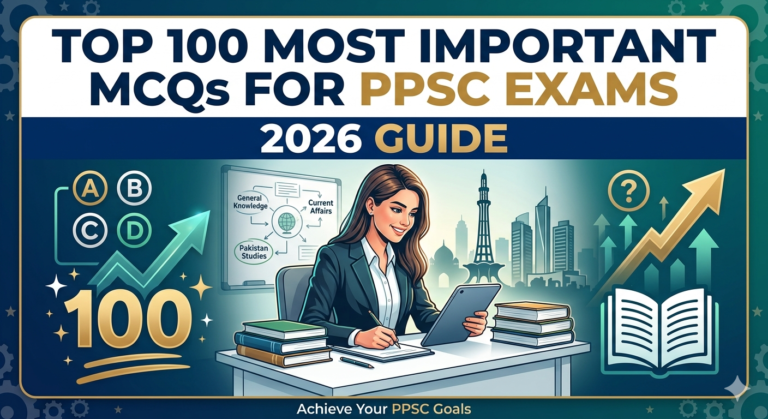
PPSC has a standard syllabus for most posts that covers General Knowledge, Pakistan Studies, Islamic Studies (Islamiyat), English, Everyday Science, Current Affairs, and subject-specific content depending on the post you are applying for.

Download the official PPSC syllabus from the PPSC official website (ppsc.gop.pk) for your specific post. Read it carefully. Highlight the topics. This is your map. Without it, you are just driving without a destination.
Once you know the syllabus, you can match each topic to the right MCQ category. For example, Pakistan Studies MCQs cover history, geography, and the political structure of Pakistan. Islamiyat MCQs focus on the Holy Quran, Hadith, and Islamic history. Knowing this breakdown saves you from random, unfocused preparation.
Step 2: Start With Past Paper MCQs
PPSC past papers are gold. This is not an exaggeration.
PPSC follows patterns. Certain topics, facts, and even specific questions tend to repeat across different years and different posts. If you ignore past papers, you are essentially ignoring the most reliable hint the exam board is giving you.
Start by solving past papers from at least the last five to ten years. As you practice, you will notice that some MCQs from older papers show up in newer ones with minor changes. This is a recurring pattern in PPSC examinations, which is why past paper MCQ practice is a non-negotiable part of any serious preparation strategy.
Platforms like MCQsDrive provide organized MCQ sets across all major PPSC subjects, which makes it easier to practice topic-wise without digging through scattered PDFs.
Step 3: Divide Your Preparation by Subject
One of the biggest mistakes candidates make is treating all subjects equally. Not every subject carries the same weight or requires the same amount of time.
Here is a practical way to divide your preparation:
General Knowledge MCQs cover a very broad range, including world geography, history, science facts, and famous personalities. You need consistent daily practice here because the scope is wide.

Pakistan Studies MCQs are heavily tested in PPSC. Focus on the history of Pakistan, constitutional history, geography, and important national events.
English MCQs test grammar, vocabulary, synonyms, antonyms, and sentence correction. Daily vocabulary building and grammar exercises help here significantly.
Islamiyat MCQs cover Quranic facts, Hadith, Islamic history, and the lives of the Prophets. This section is scoring if you prepare it consistently.
Current Affairs MCQs are time-sensitive. Keep yourself updated weekly. Follow reliable Pakistani news sources and note important national and international events.
Everyday Science MCQs test basic science concepts from biology, chemistry, and physics that apply to daily life. These are mostly conceptual and not deeply technical.
By treating each subject separately and setting weekly targets for each, you stay organized and avoid the last-minute panic that derails so many candidates.
Step 4: Set a Daily MCQ Target and Stick to It
Consistency beats intensity. Always.
A candidate who solves 50 MCQs daily for three months will outperform someone who crammed 500 MCQs in a single weekend. Your brain needs spaced repetition to actually retain information, and daily practice builds that habit naturally.
Set a realistic daily target. If you are working full time, even 30 to 50 MCQs per day is enough, provided you review your mistakes. If you have more time, aim for 80 to 100.
The review part is where most candidates fail. They solve MCQs, check how many they got right, and move on. That is not how learning works. When you get an answer wrong, spend an extra two minutes understanding why the correct answer is correct. That two minutes is worth more than the ten minutes you spent solving the MCQs in the first place.
Step 5: Track Your Weak Areas and Attack Them
Everyone has weak spots. The goal is not to hide from them but to hunt them down.
As you practice, keep a simple notebook or digital note of topics where you keep getting answers wrong. Maybe it is the constitutional amendments of Pakistan. Maybe it is English tenses. Whatever it is, flag it.
Once a week, revisit those weak areas and practice a focused set of MCQs specifically on those topics. This targeted approach fixes your gaps faster than general practice ever will.
This is also where topic-wise MCQ platforms become extremely useful. Instead of sifting through random questions, you can directly practice MCQs on constitutional history, or synonyms, or chemical reactions, in one focused session.
Step 6: Simulate Real Exam Conditions
Reading MCQs casually at your own pace is very different from answering them under a timed, pressured environment. PPSC exams have strict time limits, and many candidates lose marks not because they do not know the answers, but because they run out of time.
At least once a week, sit down and solve a full mock test under real exam conditions. Set a timer. Do not use your notes. Do not pause. Treat it exactly like the actual exam.
This trains your brain to work faster, builds your confidence, and reveals timing issues before the actual exam day. It also reduces exam anxiety, because familiarity with the pressure environment makes a real difference on test day.
Step 7: Use Reliable Online MCQ Resources
Not all MCQ sources are equal. Some platforms have outdated content, incorrect answers, or poorly structured questions. Using the wrong source can actually hurt your preparation by filling your memory with wrong information.

Always use platforms that organize MCQs by subject, topic, and difficulty level. MCQsDrive covers all major PPSC subjects including General Knowledge, Pakistan Studies, Islamiyat, English, Urdu, Maths, Everyday Science, and more. It keeps content structured so that your preparation stays focused and relevant.
Reliable, organized MCQ practice reduces wasted time and builds genuine confidence going into the exam.
Conclusion:
PPSC preparation is not about who studies the hardest for the last two weeks. It is about who builds a smarter, more consistent system over time.
Start with the syllabus. Build your foundation with past papers. Divide your subjects intelligently. Practice MCQs daily. Review your mistakes. Simulate exam conditions. And use resources that are actually reliable.
The candidates who clear PPSC are not necessarily the smartest people in the room. They are the ones who showed up consistently and practiced the right way. That is fully within your control.
FAQs
Q1: What is the best way to prepare for PPSC exams?
The best way to prepare for PPSC exams is to start with the official syllabus, practice past paper MCQs regularly, divide your preparation by subject, and review your mistakes daily. Consistent MCQ practice builds the pattern recognition and active recall skills that PPSC written tests directly reward.
Q2: How many MCQs should I practice daily for PPSC?
For working candidates, 30 to 50 MCQs per day is a solid and sustainable target. If you have more free time, aim for 80 to 100. What matters more than the number is reviewing every wrong answer so your brain actually learns from each mistake.
Q3: Which subjects are included in the PPSC exam syllabus?
Most PPSC posts test General Knowledge, Pakistan Studies, Islamiyat, English, Everyday Science, Current Affairs, Urdu, and Maths. Some posts also include subject-specific MCQs depending on the nature of the job. Always confirm the exact syllabus from the official PPSC website at ppsc.gop.pk.
Q4: Are past papers important for PPSC preparation?
Yes, past papers are one of the most important preparation tools for PPSC. PPSC follows repeating patterns, and certain topics and questions appear across multiple years with minor changes. Solving past papers from the last five to ten years gives you a clear picture of what to expect.
Q5: Where can I find reliable MCQs for PPSC preparation?
You can practice subject-wise and topic-wise MCQs on MCQsDrive (mcqsdrive.com), which covers all major PPSC subjects including General Knowledge, Pakistan Studies, Islamiyat, English, Everyday Science, and more. Always use structured and updated platforms to avoid practicing incorrect information.
Q6: How do I improve my weak areas for PPSC?
Keep a note of topics where you consistently get answers wrong during MCQ practice. Each week, dedicate a focused session specifically to those weak topics. Topic-wise MCQ platforms make this easier because you can drill into a single subject without distraction until your accuracy improves.