How to Improve Your General Knowledge for Competitive Exams in Pakistan (2025 Guide)
General Knowledge is the backbone of almost every competitive exam in Pakistan. Whether you are preparing for PPSC, FPSC, NTS, CSS, PMS, or any other government job test, a strong foundation in General Knowledge can make a decisive difference in your final score.
Yet, General Knowledge is also the section that most candidates take lightly. Many students assume they already know enough about the world around them. But when they sit in the exam hall and face questions about constitutional articles, Pak-China relations, historical events, or geographic facts, they realize how much they had underestimated this section.
The truth is that General Knowledge is not something you can cram in a single night. It is built gradually through consistent reading, smart study habits, and regular MCQ practice. In this complete guide, you will learn exactly how to improve your General Knowledge for competitive exams in Pakistan, which topics to focus on, which resources to use, and how to retain information effectively for the long term.
What Is General Knowledge in the Context of Pakistani Competitive Exams?
In Pakistani competitive exams, General Knowledge is a broad term that typically includes several interconnected subjects. It is not limited to random trivia. It covers a defined set of topics that appear repeatedly across different exams conducted by bodies like NTS, PPSC, FPSC, and SPSC.
Subjects Included in General Knowledge for Pakistani Exams
Pakistan Studies and Pakistan Affairs
This is the most heavily tested GK area in Pakistani competitive exams. It covers the geography of Pakistan, history from 1947 to present, political system, constitution, national symbols, economy, foreign policy, and major events. Questions from this section appear in almost every exam regardless of the post or department.
Islamic Studies and Islamiyat
Islamiyat is a compulsory part of most Pakistani competitive exams. It includes the life of Prophet Muhammad (PBUH), Islamic history, Quranic knowledge, names of prophets, Ashra Mubashara, pillars of Islam, and important battles. These questions are generally straightforward and easy to score if prepared properly.
Current Affairs
Current Affairs refers to recent national and international events. It includes developments in Pakistani politics, economy, international relations, science and technology, sports, climate, and global organizations like the UN, IMF, and World Bank. Current affairs questions change every few months, so this section requires regular updates.
World General Knowledge
This section covers world capitals and currencies, major rivers, mountain ranges, oceans, continents, world organizations, Nobel Prize winners, international agreements, and famous historical events. It is broader in scope but follows predictable patterns in Pakistani exams.
Science and Everyday Science
Everyday Science questions cover basic concepts from physics, chemistry, and biology as they apply to daily life. Topics include the human body, common diseases, inventions, scientific discoveries, environmental science, and simple physics concepts. These questions do not require deep technical knowledge but do require awareness.
Computer and Information Technology Basics
With the increasing digitization of government departments, basic computer knowledge has become part of General Knowledge sections in many exams. Topics include MS Office basics, internet terminology, hardware and software concepts, and general IT awareness.
Why Most Candidates Struggle With General Knowledge
Before understanding how to improve, it is important to understand why candidates struggle with GK in competitive exams.
The first reason is lack of consistency. General Knowledge cannot be prepared in a few days. It requires weeks and months of reading and revision. Candidates who start preparation late often find themselves overwhelmed by the vast amount of information.
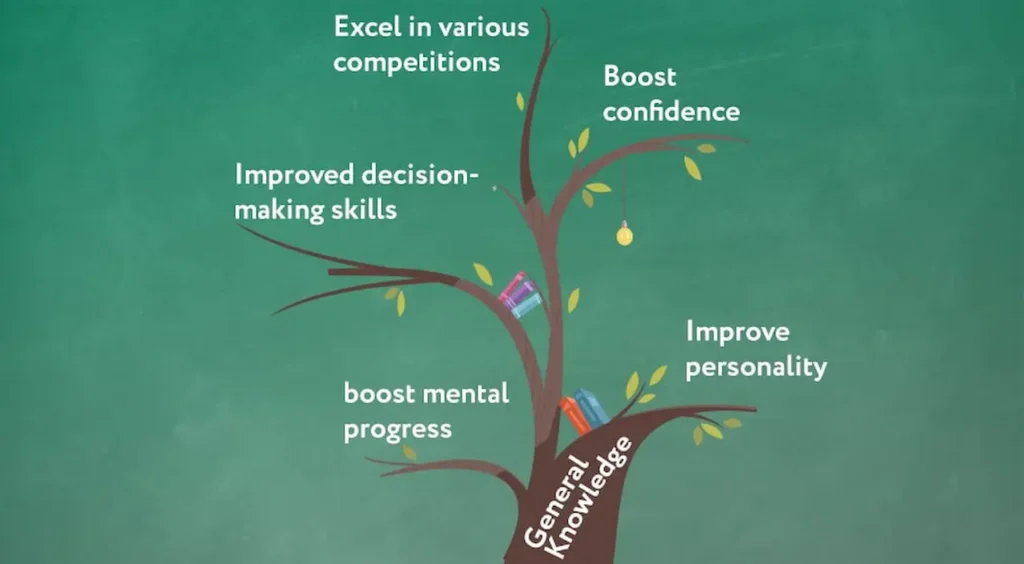
The second reason is poor source selection. Many candidates read from too many sources and end up confused. Using five different books for the same topic wastes time and creates information overload.
The third reason is passive reading without practice. Reading about a topic and answering MCQs on the same topic are two very different skills. Candidates who only read and never practice MCQs struggle to recall information under exam pressure.
The fourth reason is ignoring Current Affairs. Many candidates focus only on static GK like history and geography but skip current affairs. In recent exams, current affairs questions have increased significantly in number.
The fifth reason is weak revision habits. Even if you study a topic today, you will forget most of it within a week without revision. Candidates who do not revise regularly retain very little by exam day.
How to Improve General Knowledge for Competitive Exams: Complete Strategy
Step 1: Know Your Exam Syllabus First
Every competitive exam in Pakistan has a defined syllabus. Before you start preparing General Knowledge, download the official syllabus or past papers of the exam you are targeting. Look at how many GK questions appear, which topics are tested most frequently, and what the weightage of each subject is.
For example, PPSC tests for clerical posts include heavy Pakistan Studies and Islamiyat sections, while CSS exams require deep knowledge of world affairs and analytical writing. NTS tests for teaching positions focus more on pedagogy and subject knowledge along with basic GK.
Knowing your specific exam requirements helps you prioritize the right topics and avoid wasting time on irrelevant material.
Step 2: Build a Strong Foundation in Pakistan Studies
Pakistan Studies is non-negotiable for any competitive exam in Pakistan. Start by preparing the following core areas:
Geography of Pakistan including provinces, districts, rivers, dams, mountain ranges, and borders with neighboring countries. Know the length of major rivers, heights of famous peaks, and locations of important dams like Tarbela, Mangla, and Diamer Bhasha.
History of Pakistan from the movement for independence, partition in 1947, major wars with India in 1948, 1965, and 1971, the making and breaking of constitutions, and important political events up to the present day.
Constitutional knowledge is extremely important. Know the key articles of the Constitution of Pakistan 1973. Topics like fundamental rights, Emergency provisions, structure of Parliament, powers of the President and Prime Minister, and the role of the judiciary appear frequently.
National symbols including the national anthem writer, national flag dimensions, national animal, bird, flower, sport, and language are commonly asked in objective-type exams.
Step 3: Master Islamiyat Basics
Islamiyat preparation does not require in-depth scholarly knowledge for general competitive exams. Focus on the following areas that are tested most repeatedly:
The life of Prophet Muhammad (PBUH) including birth, early life, Hijrat, important battles like Badr, Uhud, and Khandaq, and the year of passing. Names of wives and close companions of the Prophet (PBUH) are also frequently tested.
The Holy Quran: Know the number of Surahs (114), total verses (6236), total Ruku (540), and the names of longest and shortest Surahs. Know which Surah is called the heart of the Quran and which was revealed first and last.
Ashra Mubashara, pillars of Islam, articles of faith, and important Islamic dates are standard GK topics that appear across all Pakistani competitive exams.
Step 4: Stay Updated With Current Affairs Every Day
Current Affairs is a dynamic section that rewards candidates who read regularly. Here is how to stay updated effectively:
Read a national English or Urdu newspaper every morning. Dawn, The News, Jang, and Geo News are reliable sources. Focus on the front page, editorial section, and national and international news pages.
Follow trusted current affairs summaries available on MCQ preparation platforms. Platforms like MCQsDrive offer monthly current affairs MCQs that are tailored specifically for Pakistani competitive exam candidates.
Keep a current affairs notebook. Every week, write down 10 to 15 key facts: new appointments, government decisions, international agreements, records broken, and major world events. Review this notebook every Sunday.
Focus specifically on Pakistan’s foreign relations, economy, major development projects like CPEC, climate and environmental news, and sports achievements at the international level.
Step 5: Study World General Knowledge Strategically
World GK is broad, but the questions that appear in Pakistani competitive exams follow predictable patterns. You do not need to memorize every capital in the world. Focus on the following high-frequency areas:
Capitals and currencies of important countries especially neighboring countries of Pakistan and major world powers like the USA, UK, China, Russia, France, Germany, and Saudi Arabia.
World organizations including the United Nations, World Health Organization, IMF, World Bank, NATO, SCO, OIC, SAARC, and ASEAN. Know their headquarters, founding years, and purposes.
Major rivers and mountains of the world. Know the longest river (Nile or Amazon depending on the source), highest mountain (Everest), largest ocean, largest continent, and smallest country.
Famous inventions and inventors. Questions about who invented the telephone, airplane, printing press, penicillin, and other major inventions appear regularly in Pakistani GK sections.
Step 6: Practice Everyday Science MCQs Regularly
Everyday Science questions are based on general awareness of scientific concepts. You do not need to be a science graduate to answer these correctly. Focus on:
Basic facts about the human body: number of bones, functions of organs, common diseases and their causes, vitamins and deficiencies, and the immune system.
Common physics concepts: speed of light, speed of sound, boiling and freezing points, force and gravity, and simple machine principles.
Chemistry basics: elements and their symbols, common chemical formulas like water (H2O) and salt (NaCl), acids and bases, and atmospheric composition.
Environment and ecology: greenhouse effect, global warming, ozone layer, major ecosystems, and environmental organizations.
Step 7: Solve MCQs Every Single Day
Reading alone is not enough to score well in competitive exams. You must practice MCQs daily to test your knowledge, identify gaps, and build exam-level speed and accuracy.
Platforms like MCQsDrive offer thousands of well-organized MCQs across all GK subjects including General Knowledge, Pakistan Studies, Islamiyat, Everyday Science, Current Affairs, and more. The categorized format allows you to practice topic by topic.
Set a target of solving at least 50 to 100 GK MCQs every day. Review every wrong answer and understand why it was wrong. This habit of learning from mistakes is what separates average candidates from top scorers.
Step 8: Revise Regularly Using Short Notes
Revision is the most underrated part of General Knowledge preparation. Without regular revision, you will forget 70 percent of what you studied within a week.
Create short revision notes for every topic you study. Use bullet points and numbered lists to summarize key facts. For example, after studying Pakistan’s rivers, write a one-page note with names, lengths, origins, and provinces. Keep these notes organized in a folder or notebook.
Follow the spaced repetition technique. Revise a topic after one day, then after three days, then after one week, then after two weeks. This method is proven to improve long-term retention significantly.
Daily Habits That Build Strong General Knowledge Over Time
Improving General Knowledge is not just about studying for exams. It is about building daily habits that keep your awareness sharp and your knowledge current.
Read a Newspaper Every Morning
Make it a non-negotiable habit to read a newspaper for 20 to 30 minutes every morning. You do not need to read every article. Focus on headlines, editorials, and major national and international stories. Over weeks and months, this habit builds an enormous base of current and historical awareness.
Watch News in Urdu or English
If reading a newspaper is difficult due to time constraints, watch a 30-minute news bulletin daily. Pakistani news channels like Geo, ARY, and Dawn News provide reliable coverage of current events. Pay attention to names, dates, facts, and figures mentioned in news reports.
Listen to Educational Podcasts and YouTube Channels
Several Pakistani YouTube channels offer free GK preparation content in Urdu for competitive exams. Search for NTS GK preparation, PPSC General Knowledge, and Pakistan current affairs channels. These are especially helpful for auditory learners.
Use Flashcards for Memorization
For static GK facts like capitals, currencies, national symbols, and constitutional articles, flashcards are highly effective. Write the question on one side and the answer on the other. Review them during breaks, commutes, or before sleeping.
Discuss Topics With Fellow Aspirants
Joining a study group or online community of competitive exam aspirants can significantly boost your GK preparation. Discussing topics, quizzing each other, and sharing resources keeps you motivated and exposes you to information you may have missed.
Best Resources for General Knowledge Preparation in Pakistan
MCQsDrive (mcqsdrive.com)
MCQsDrive is one of the best online platforms for General Knowledge MCQ practice in Pakistan. It offers comprehensive subject-wise MCQs covering Pakistan Studies, Islamiyat, General Knowledge, Current Affairs, Everyday Science, and more. The platform is updated regularly and is specifically designed for candidates preparing for NTS, PPSC, FPSC, CSS, and similar exams.
Caravan General Knowledge Book
Caravan’s General Knowledge guide is one of the most popular books among competitive exam candidates in Pakistan. It covers Pakistan Studies, World GK, Islamiyat, and Current Affairs in a concise and exam-relevant format.
NTS and PPSC Past Papers
Past papers are your most reliable source of exam-relevant GK. They show you exactly which topics are repeated, how questions are framed, and what level of detail is expected. Collect at least 10 to 15 past papers of your target exam and study them carefully.
Dawn News and The News International
For current affairs, Dawn and The News are the most reliable English-language sources. Reading their online editions daily is free and highly effective.
Pakistan’s Official Government Websites
For accurate constitutional, geographic, and statistical information about Pakistan, official government websites like the Pakistan Bureau of Statistics, Election Commission of Pakistan, and the National Assembly website are authoritative sources.
Topic-Wise High-Frequency GK Questions for Pakistani Competitive Exams
Based on patterns observed across PPSC, NTS, FPSC, and CSS past papers, the following topics appear most frequently in GK sections:
Pakistan’s constitution, articles, and amendments appear in nearly every exam. Know at least the first 25 articles related to fundamental rights.
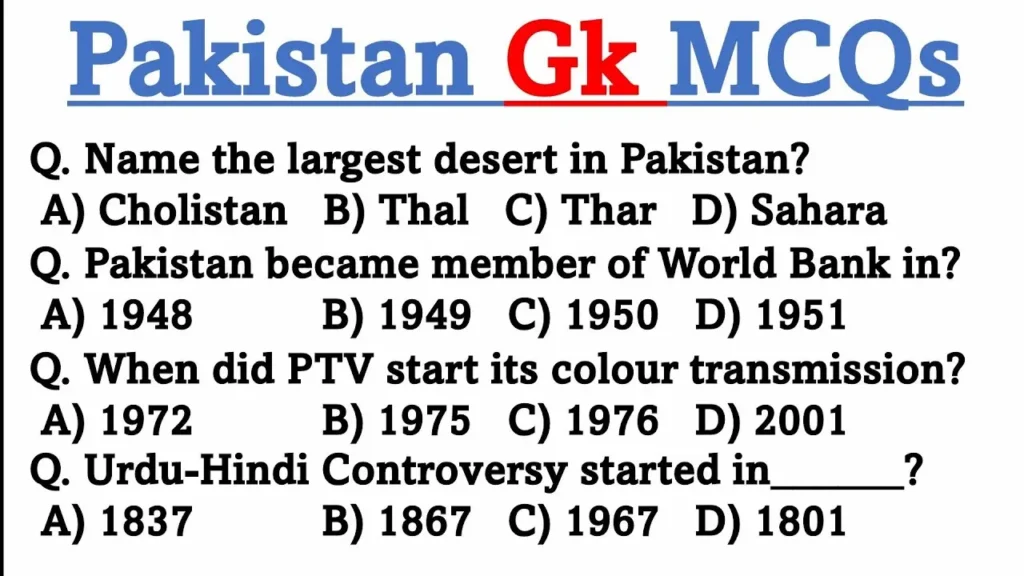
Names, terms, and roles of Presidents and Prime Ministers of Pakistan from 1947 to present are tested repeatedly.
Important facts about CPEC, major foreign policy decisions, and Pakistan’s relationships with China, USA, Saudi Arabia, and India.
Nobel Prize winners, especially those from Muslim-majority countries and recent years.
United Nations founding, structure, Security Council members, and major UN agencies and their purposes.
Olympic and cricket records related to Pakistan, especially World Cup victories and notable individual achievements.
Scientific inventions and the years they were made, with special focus on 19th and 20th century discoveries.
Geographic records: highest peak in Pakistan (K2 at 8611 meters), longest river (Indus), largest province by area (Balochistan), most populated province (Punjab), and smallest province (Khyber Pakhtunkhwa by area after FATA merger).
How to Memorize and Retain General Knowledge for Longer
Use Association Techniques
Connect new facts to things you already know. For example, to remember that the capital of Australia is Canberra and not Sydney, associate Canberra with “can” meaning able to remember. Creating mental associations makes recall faster and more reliable.
Write What You Learn
Research shows that writing information by hand significantly improves retention compared to just reading. After studying a topic, close the book and write down everything you remember. This active recall technique is one of the most powerful memory strategies.
Teach What You Know
If you can explain a topic to someone else, you have truly understood it. Teach GK facts to a sibling, friend, or fellow aspirant. Teaching forces your brain to organize and simplify information, which strengthens memory significantly.
Sleep and Exercise Regularly
Memory consolidation happens during sleep. Candidates who study hard but sleep less than 6 hours per night retain far less than those who sleep 7 to 8 hours. Regular physical exercise also improves concentration and cognitive performance. Do not sacrifice health for study hours.
Conclusion
Improving your General Knowledge for competitive exams in Pakistan is a long-term investment that pays off enormously. It is not about memorizing random facts. It is about building a broad, organized, and regularly updated knowledge base that allows you to answer a wide variety of MCQs confidently and accurately.
The candidates who consistently score high in GK sections of PPSC, FPSC, NTS, and CSS exams are not necessarily more intelligent. They are simply more consistent. They read daily, practice MCQs regularly, revise frequently, and never stop learning.
Start today. Even 30 minutes of focused GK reading per day, combined with 50 MCQs on a platform like MCQsDrive, will produce visible results within a few weeks. By the time your exam arrives, you will have built a knowledge foundation that is broad, deep, and exam-ready.
Pakistan’s competitive exam landscape is tough but fair. Knowledge, consistency, and smart preparation always win.
FAQs About Improving General Knowledge for Pakistani Competitive Exams
How long does it take to build strong General Knowledge for competitive exams?
There is no fixed timeline. However, with consistent daily effort of 1 to 2 hours, most candidates see a significant improvement in 60 to 90 days. Starting at least 3 to 4 months before your exam is ideal for thorough GK preparation.
Is General Knowledge the same for all Pakistani competitive exams?
The core topics are largely similar across PPSC, NTS, FPSC, and CSS. However, the depth and weightage vary. CSS requires much deeper analytical knowledge of world affairs and Pakistan’s history, while NTS tests for lower-grade posts focus more on basic Pakistan Studies and Islamiyat MCQs.
What is the fastest way to improve General Knowledge before an exam?
The fastest method is to solve at least 100 GK MCQs daily from past papers and platforms like MCQsDrive, read a newspaper summary every morning, and revise your short notes every evening. This intensive approach can produce significant improvement even in 2 to 3 weeks.
Which topic is most important in General Knowledge for PPSC exams?
Pakistan Studies and Current Affairs are the most heavily weighted GK topics in PPSC exams. Constitutional knowledge, geography of Pakistan, and major historical events from 1947 onwards are particularly important for PPSC preparation.
Can I prepare General Knowledge without a coaching center?
Absolutely. The majority of successful candidates in Pakistani competitive exams prepare through self-study. With quality resources like MCQsDrive, past papers, good books like Caravan GK Guide, and daily newspaper reading, coaching is not necessary for GK preparation.
How many GK MCQs should I practice every day?
Aim for a minimum of 50 MCQs per day during regular preparation and increase to 100 MCQs per day in the final two to three weeks before your exam. Daily practice builds speed, accuracy, and topic familiarity that cannot be developed through reading alone.
Is Current Affairs part of General Knowledge in competitive exams?
Yes, Current Affairs is considered a core component of General Knowledge in all major Pakistani competitive exams. Questions about recent political events, international developments, economic decisions, and appointments are standard in PPSC, FPSC, NTS, and CSS tests.
What is the best website for General Knowledge MCQ practice in Pakistan?
MCQsDrive (mcqsdrive.com) is widely regarded as one of the best platforms for General Knowledge MCQ practice in Pakistan. It offers thousands of categorized MCQs covering Pakistan Studies, Islamiyat, World GK, Everyday Science, Current Affairs, and more, making it a complete resource for competitive exam preparation.